








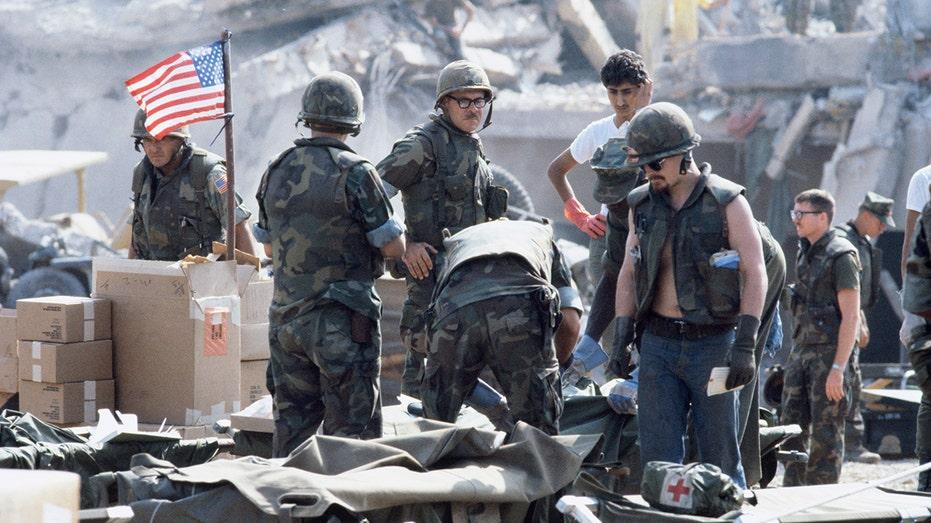
On October 23, 1983, Rabbi Arnold Resnicoff found himself unexpectedly in Beirut, a city about to be devastated by a suicide bombing that killed 241 American service members. Resnicoff, assigned to the U.S. Navy’s 6th Fleet, was in Beirut for a memorial service and, due to his observance of the Sabbath, was delayed from returning to his ship. He awoke to the cataclysmic explosion that leveled the Marine Corps barracks, a tragedy he narrowly avoided by chance, having chosen to stay with a Catholic chaplain instead of the Protestant minister whose residence was also near the blast site. Emerging into the chaos, Resnicoff witnessed the horrific destruction and the immediate aftermath, where the lack of medical personnel meant chaplains like himself and Father George Pucciarelli had to provide immediate aid, cradling the wounded and offering comfort amidst the rubble. In a poignant moment, Pucciarelli, seeing Resnicoff’s kippah soiled with blood, tore a piece of his own camouflage uniform to place on the rabbi’s head, a symbol of solidarity and shared humanity across religious divides in the face of unspeakable loss. Resnicoff later applied Jewish mourning traditions, offering silent support to grieving Marines, drawing parallels to the teachings of St. Francis of Assisi. This profound experience not only highlighted the critical role of chaplains in providing spiritual and emotional support beyond religious lines but also became a catalyst for change; the story of Pucciarelli’s gesture was instrumental in the passage of the Religious Apparel Amendment, allowing Jewish service members to wear their kippahs. Resnicoff’s account underscores a powerful message: that shared adversity can foster unity, and that ‘if the world had more interfaith foxholes, we would have less need for foxholes and more room for faith.’
Adapted from: Latest World News on Fox News