









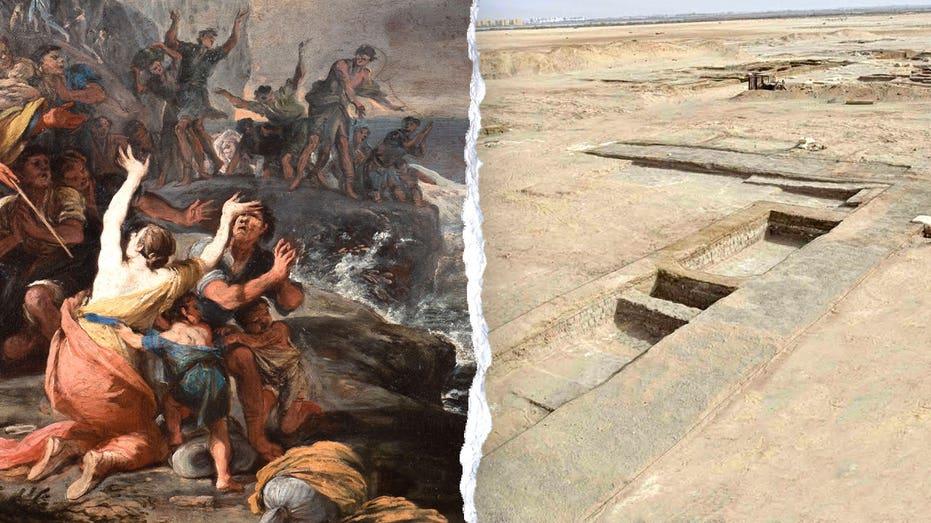
Archaeologists in Egypt have unearthed compelling evidence at Tell Abu Seifi, a fortified site in northeastern Egypt, that strongly suggests the discovery of the long-lost ancient city of Mesen, a location potentially tied to the biblical Exodus. The find, announced by the Egyptian Ministry of Tourism and Antiquities, centers on a massive sandstone lintel bearing the titles of Ramesses II, the pharaoh frequently associated with Moses and a pivotal figure of the New Kingdom era. This over 3,000-year-old lintel also contains an inscription referencing the restoration of a statue of Horus, described as “Lord of the City of Mesen,” significantly bolstering the theory that Tell Abu Seifi is indeed Mesen, a city mentioned in ancient texts. Further excavations revealed a fortified temple complex, complete with mudbrick walls, gates, storage rooms, and two ancient stone roads leading to the temple, reinforcing the hypothesis of its historical significance. The site, strategically positioned along the Horus Military Road—a route connecting Egypt with Sinai and Canaan, and potentially the “way of the land of the Philistines” mentioned in Exodus—has a rich history, with parts of it later converted into Roman military barracks. This discovery adds to a series of significant finds in Egypt this year with connections to Ramesses II and the biblical narrative, including a large statue believed to depict Ramesses II and an ancient settlement in a region historically linked to the Exodus debate, underscoring the area’s crucial role in protecting Egypt’s eastern borders throughout antiquity.
Adapted from: Travel News Today on Fox News