









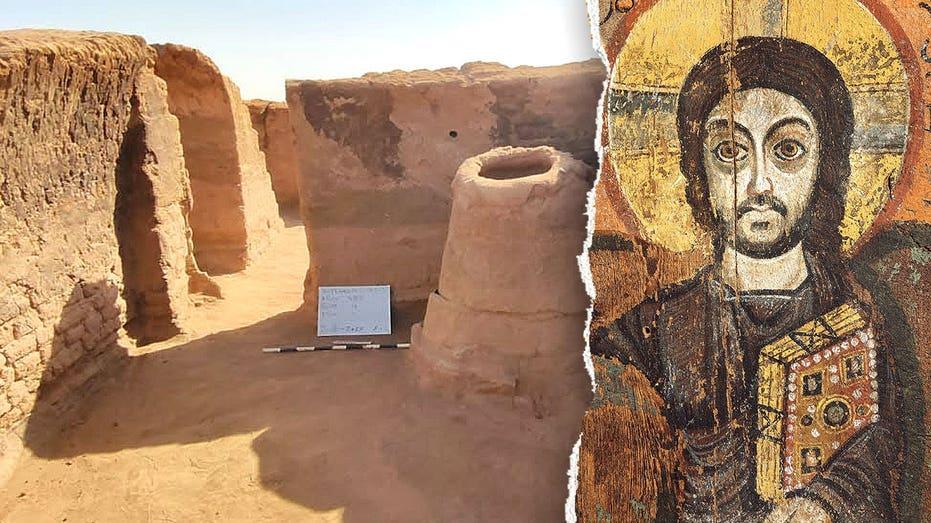
Archaeologists in Egypt have made a monumental discovery, unearthing a complete Christian city buried for 1,700 years beneath the desert sands of the Dakhla Oasis. The remarkably preserved Byzantine-era settlement, announced by Egypt’s Ministry of Tourism and Antiquities, features a basilica church dating to the mid-fourth century A.D., a fortress with thick defensive walls, watchtowers, and a complex network of houses, streets, and plazas, all constructed from mudbrick. Among the most significant finds is the well-preserved home of Tisos, a church deacon, and what is believed to be a house church predating the basilica. The city’s planned urban layout, complete with main streets and intersecting cross streets, indicates a thriving community. Artifacts recovered include household pottery, oil lamps, grain grinding tools, and a treasure trove of well-preserved bronze coins bearing images of Byzantine emperors and Christian symbols, some dating to the reign of Emperor Constantius II (337-361 A.D.). A particularly significant discovery is an archive of 200 ostraca—pieces of pottery and limestone—inscribed with Coptic and Greek texts detailing everyday life, sales transactions, and correspondence, offering an unprecedented glimpse into the lives of early Christians in one of the religion’s ancient centers.
Adapted from: Travel News Today on Fox News