










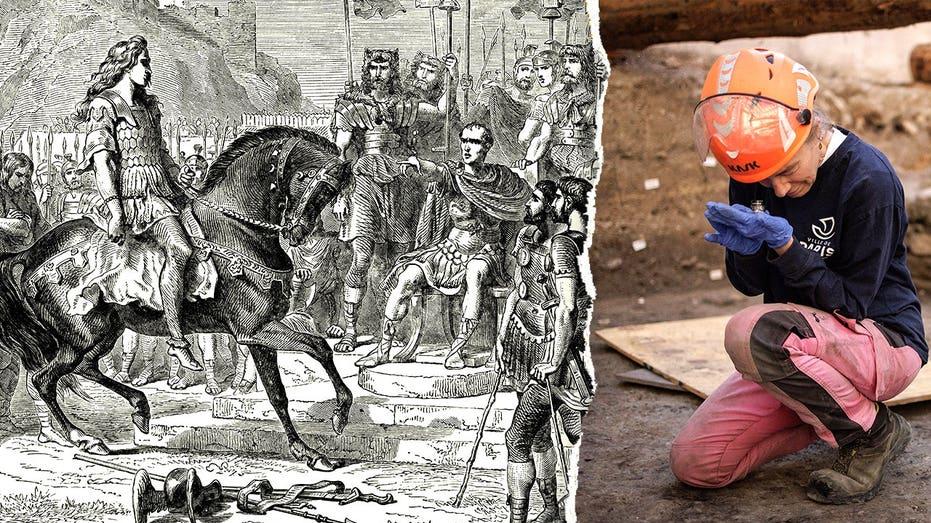
Archaeologists in Paris have unearthed a significant ancient wall, potentially belonging to the long-lost Gallic city of Lutetia, a discovery that could finally resolve a 2,000-year-old mystery documented by Julius Caesar himself. Found during excavations for a redevelopment project near Notre Dame Cathedral, the stone-and-timber structure, measuring approximately 66 feet, exhibits clear signs of extensive fire damage, mirroring accounts from Caesar’s “The Gallic Wars” where the Parisii tribe reportedly burned their fortified settlement in 52 B.C. to prevent it from falling into Roman hands. Radiocarbon testing on wooden elements within the wall dates it between 200 B.C. and 10 B.C., a timeframe that strongly aligns with Caesar’s historical records. This find is particularly crucial as conclusive archaeological evidence for Lutetia’s location has been scarce, with some theories even placing it elsewhere in the region. French Culture Minister Catherine Pégard described the discovery as potentially one of the most important for understanding Gallic Lutetia, emphasizing that while scientific verification is ongoing, the convergence of evidence is remarkable. The wall’s architecture, featuring large stone blocks and interlocking wooden beams, further supports its Gallic origin. Although the wall cannot remain in situ, plans are underway to reconstruct a portion of it for display in a Paris museum, promising to fill a significant gap in the archaeological record and provide a tangible link to the era of Julius Caesar.
Adapted from: Travel News Today on Fox News