









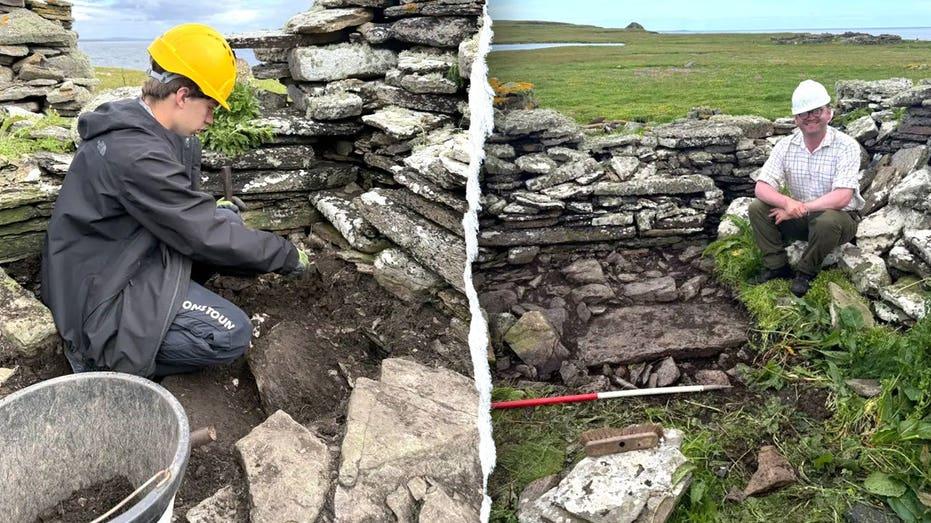
In a remarkable discovery on the deserted island of Swona in Orkney, Scotland, students from Gordonstoun, an alma mater of King Charles III, have unearthed the foundations of what is believed to be a 1,000-year-old Viking-era church. During an annual service project focused on archaeological and restoration work, the boarding school students uncovered the remains of an altar and a step within the long-known, yet historically ambiguous, ruins. While the structure was locally referred to as a ‘kirk,’ its true purpose remained uncertain until this excavation. Previously, surveys had indicated architectural features consistent with early medieval churches, including size, proportions, east-west orientation, and construction methods. The team’s targeted excavation along the inside of the east wall, anticipating the location of an altar, quickly revealed its foundational base and an adjacent step, providing compelling evidence to support the local legend. This discovery, likely dating to the 10th or 11th century, aligns with other known Viking-era churches in the region, offering a tangible link to the island’s past and shedding light on the spread of Christianity in remote communities. The students involved described the experience as surreal, marveling at the survival of ancient structures like the altar and doorway, which remained surprisingly visible despite centuries of erosion. The project, a collaboration with the island’s owners and the Swona Heritage Group, involved a challenging journey for the students, who also undertook restoration of a local house and utilized a 1,000-year-old well for water. Future plans include creating a 3D model of the church and further archaeological analysis to better understand its age and historical significance.
Adapted from: Travel News Today on Fox News