









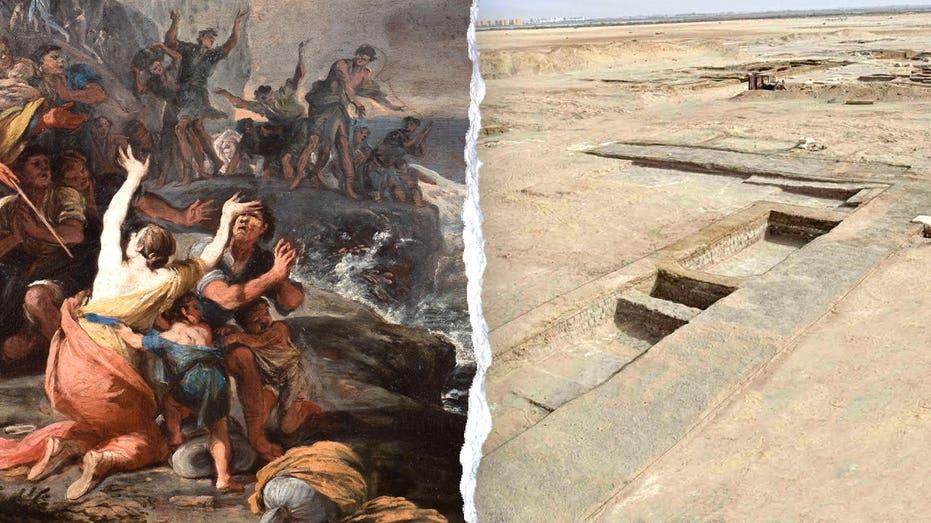
Archaeologists in Egypt may have discovered the lost ancient city of Mesen, a fortified site on the Horus Military Road, a strategic route potentially linked to the biblical Exodus narrative. The recent excavation at Tell Abu Seifi yielded a significant sandstone lintel bearing the titles of Ramesses II, the pharaoh often associated with Moses, dating back over 3,000 years. This lintel includes an inscription mentioning the restoration of a statue of Horus, described as “Lord of the City of Mesen,” strengthening the hypothesis that Tell Abu Seifi is indeed Mesen, a city referenced in New Kingdom texts. Further discoveries include the remains of a fortified temple complex with mudbrick walls, gates, storage rooms, and ancient stone roads, alongside fragments of falcon statues. The site’s historical significance is underscored by its later use as a Roman military barracks in the 3rd century AD. These findings are considered a crucial addition to understanding North Sinai’s historical role in protecting Egypt’s borders and add to a series of recent Egyptian discoveries with potential ties to Ramesses II and the biblical world, including a massive statue of Ramesses II and an ancient settlement in a region debated as a setting for the Exodus.
Adapted from: Travel News Today on Fox News