










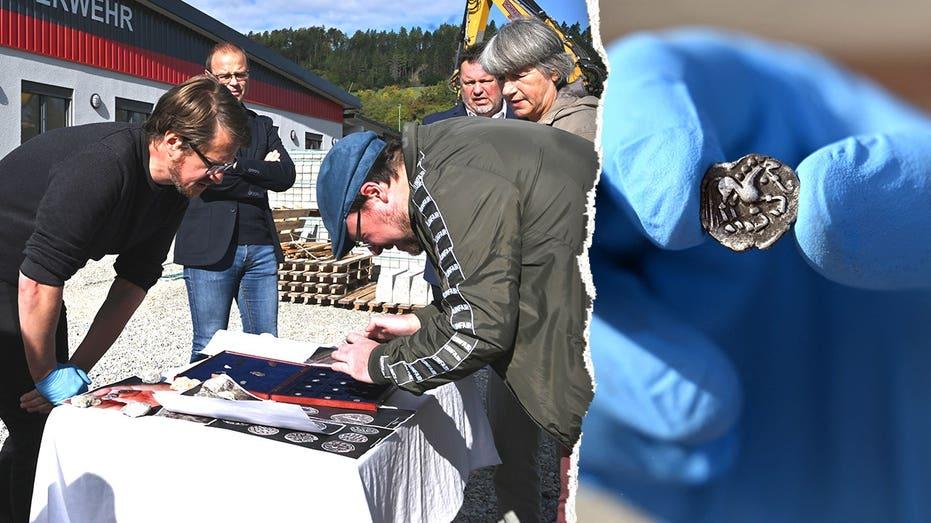
A remarkable discovery has been made in Thuringia, Germany, where archaeologists, while excavating a former sports field for a new fire station, unearthed a hoard of 11 ancient Celtic coins dating back to the first century B.C. This find, identified as Prague-type quinarii, represents the largest known Celtic coin hoard from this era ever found in the region, significantly expanding our understanding of ancient trade routes and production centers. The coins, believed to have been buried in an organic container that has since decomposed, were found scattered across an area of approximately 19 by 5 feet, likely due to plowing over the centuries. Archaeologists consider this a ‘closed find,’ meaning all coins originally buried together were recovered, and its significance lies not just in the quantity but in the historical data it provides. Alongside the Celtic coins, the excavation also yielded an ancient Roman coin, a medieval glass bead, a knife fragment, another silver coin, and a 19th or 20th-century Prussian uniform button, underscoring the rich archaeological context of the site and highlighting the importance of proper, documented excavation practices over unrecorded metal detecting finds.
Adapted from: Travel News Today on Fox News